
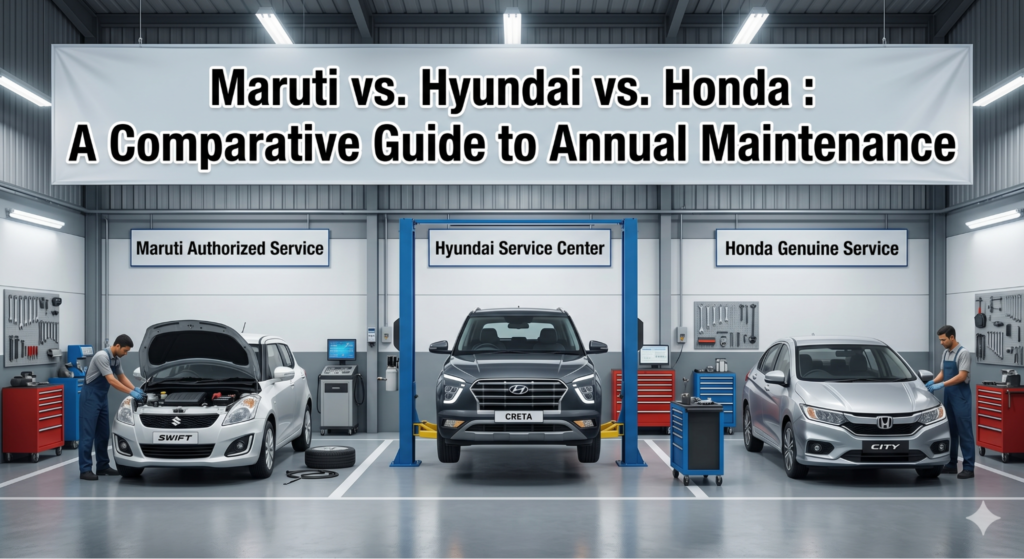
Buying a car in 2026 feels deceptively simple: you compare ex-showroom prices, pick a color, and sign the papers. But the sticker price typically covers only about 60% of what a car will actually cost you over the first five years. The remaining 40% comes from routine maintenance, consumables, occasional car repairs, and regional service-cost variations all amplified this year by tighter BS6 Phase 2.0 emissions norms. Buying original car spare parts online in India is now a trend as people now trust ecommerce platforms for providing genuine spare parts. Those regulations have nudged manufacturers toward more complex after-treatment systems, increased use of advanced lubricants, and a greater reliance on electronics changes that raise fluid costs and technician time in workshops across India.
Against this backdrop, three manufacturers continue to dominate family ownership in India: Maruti Suzuki, Hyundai, and Honda. They represent three distinct philosophies: Maruti offers low-cost, high-volume simplicity; Hyundai brings tech-forward features and a slightly higher maintenance profile; Honda focuses on engineering longevity and predictable service intervals.
Below is the break-down of what each brand means for your wallet in 2026, then look at five-year totals and practical tips to keep costs down.
2026 maintenance benchmark (high-level)
- Brand: Maruti Suzuki — Typical annual service cost: Low
- Brand: Hyundai — Typical annual service cost: Moderate
- Brand: Honda — Typical annual service cost: Moderate-high
A. Maruti Suzuki: the “volume” advantage
Why it’s cheapest: Maruti’s cost advantage is structural. Their engine and gearbox designs emphasize mechanical simplicity, and the Maruti Genuine Parts (MGP) supply chain is the largest and most mature in India. That scale keeps part lead times short and component prices competitive.
Labor costs: Maruti’s service network is tiered. Arena workshops handle the mass-market models and standard maintenance at lower labor rates; Nexa outlets, aimed at premium buyers, charge a bit more for labor and accessories. For budget-conscious owners, choosing Arena for routine jobs can reduce bills by 8–12%.
Key models: Alto K10 and Swift remain inexpensive to maintain. The Brezza 1.5L has earned the informal title “Service King” among small SUVs because its naturally aspirated 1.5L is mechanically straightforward and parts are abundant which translates directly to lower repair bills and faster turnaround.
B. Hyundai: the “premium” tech tax
The shift: Hyundai’s recent push into turbo-petrol 1.0L/1.5L engines and DCT (dual-clutch transmission) gearboxes improves drivability and fuel efficiency but increases complexity. Turbochargers, direct injection, and electronic clutches require more specialized diagnostics and occasionally more expensive replacement parts.
The “free” trap: Hyundai often offers complimentary labor and service packages for the first two or three years. While attractive up front, owners frequently see a service-cost spike in years three and four when the free labor period ends and wear items (brake pads, discs) and software updates start appearing on the bill.
Key models: Grand i10 Nios is cheaper to keep if driven gently; the Creta — especially in diesel or turbo petrol variants — can be costlier due to heavier components and pricier consumables.
C. Honda: the “reliability” premium
Parts longevity: Honda tends to design components for longevity rather than the lowest price point. That often means a slightly higher price for replacement parts but fewer replacements overall — in practical terms, Honda parts can last about 20% longer on average versus rivals in similar usage patterns.
Service intervals: Honda commonly recommends 10,000 km or 1 year between major checks, and its telematics platform (Honda Connect 2.0) now provides predictive alerts for wear items. That predictability reduces surprise costs but means you pay reliably every interval.
Key models: The Amaze is relatively cheap to maintain for a sedan. The City e:HEV introduces hybrid-specific considerations: regenerative braking reduces wear on friction brakes but hybrid battery health and inverter diagnostics become new items on the maintenance checklist.
5-year cumulative cost analysis (the TCO factor)
When you roll up Year 1 to Year 5 costs, three buckets dominate: consumables, wear-and-tear parts, and periodic major servicing.
- Consumables: Synthetic engine oils tuned to BS6 Phase 2.0 requirements are pricier in 2026. Expect synthetic oil change costs to be 10–18% higher than 2023 levels, with Hyundai turbo engines typically requiring premium low-SAPS oils. Transmission fluids for DCT/CVTs are also more expensive and replaced less frequently but cost more per service.
- Wear & tear: Brake pads typically need replacement every 30k–50k km depending on driving style; expect 5-year pad replacements for most urban owners. Batteries in 2026 remain a weak link in hot climates; lead-acid 35–45 Ah batteries last 2–4 years, while higher-end SMF/AGM units stretch to 4–6 years at a higher upfront cost.
- Spikes: The major 40,000 km service is often where costs jump — full fluid flushes, timing inspection, fuel-system cleaning, and sometimes suspension or clutch checks. Budget an extra 20–35% for that service compared with a typical interim oil-and-filter job.
Putting numbers together: over five years, a Maruti owner often spends the least, Hyundai owners fall in the middle but face steeper mid-term spikes, and Honda owners may pay a bit more steadily but with fewer surprise replacements thanks to durable parts.
Factors influencing your bill in 2026
- City-specific labor rates: Geographic location matters. Workshops in Bangalore and Mumbai typically charge 12–18% more labor than mid-tier cities like Jaipur or Lucknow, driven by higher operating costs and technician wages. If you’re a city-hopper, log service history carefully to preserve resale value when service centers vary.
- Fuel type impact: CNG conversions reduce fuel cost but can slightly increase maintenance frequency for intake and valve-related systems unless the vehicle is factory-fitted. Strong hybrids reduce mechanical wear on brakes and engines but introduce battery-monitoring, inverter coolant changes, and sometimes more expensive diagnostic sessions.
- Digital tools: OEM service calculators and official maintenance schedules are now essential. Use them to compare quoted service items with OEM guidance; this helps avoid unnecessary upselling at independent workshops. Many brands publish online service-cost estimators — run your model through one before approving large bills.
Practical example: If you own a Maruti Brezza in Mumbai and drive 12k–15k km/year, expect Year 1–2 annual maintenance around a modest figure due to simplicity and parts availability; Year 3–4 see modest increases for brakes and tires; Year 5 includes the major 40k km service. A comparable Hyundai Creta may start similarly thanks to loyalty packages, but post-warranty years spike due to DCT service needs. A Honda City owner will likely see steadier, slightly higher annual spends but fewer mid-term surprises.
Conclusion
- Best for budget: Maruti Suzuki. If minimizing five-year TCO is your top priority, Maruti’s scale, parts availability, and simple mechanicals make it the safest bet.
- Best for urban sophistication: Hyundai. For buyers who value feature-rich cabins and peppy turbo drivetrains, Hyundai delivers but accepts a slightly higher maintenance curve.
- Best for long-term peace of mind: Honda. If you prioritize durability and predictable service schedules, Honda’s approach to longevity rewards patient owners.
A note for shoppers: Carkayaar’s independent parts insights and comparison guides are useful if you want to check aftermarket options for consumables or find cost-effective service alternatives, but always cross-check compatibility and warranties before deviating from OEM recommendations.
Frequently Asked Questions
Is Honda more expensive to maintain than Hyundai in 2026?
Not necessarily. Honda tends to have higher-priced parts but fewer replacements thanks to longevity, so its five-year total can be comparable or slightly higher than Hyundai depending on model and driving profile. Hyundai models with turbo engines and DCTs tend to show steeper mid-term maintenance costs.
What is the average service cost for a Maruti Brezza in 2026?
Typical annual service for a Brezza doing moderate city kilometers (5k–8k/year) ranges from economical routine jobs up to a larger bill at the 40k km major service. Expect modest yearly spends with a notable jump at the major service — plan for that spike in your budget.
Do hybrids cost more to service than standard petrol cars?
Hybrids often lower some consumable costs (reduced brake and engine wear) but add hybrid-specific items such as battery health checks, inverter diagnostics, and coolant changes. Over five years, mild hybrids and strong hybrids can be cost-neutral or slightly more expensive depending on battery warranty and replacement likelihood.
How much can switching to aftermarket parts save me, and is it safe?
Aftermarket consumables (filters, brake pads, wiper blades) can save 20–40% versus OEM prices, and many reputable brands meet or come close to OEM specs. Save cautiously: avoid cheap knockoffs for critical parts (brake pads, suspension components, airbags). Always check part certification, warranty, and compatibility; for emissions- or warranty-sensitive items (catalysts, ECU-related parts), stick to OEM or dealer-approved options.
Can regular DIY checks actually cut five-year costs?
Yes—simple DIY maintenance can reduce small-ticket visits and catch issues early. Regular checks include tyre pressure and tread, engine-oil level, coolant level, battery terminals, and brake-pad thickness. These habits can extend consumable life and prevent breakdowns, saving 5–12% over five years. Don’t attempt complex repairs (airbag, hybrid battery, DCT internals); leave those to trained technicians to avoid costly mistakes.

Mr. Ashish Kumar is the Founder of Carkayaar (Car Ka Yaar) and has more than 10 years of experience in the Indian automotive industry. He has spent years helping car owners, workshops, and businesses find genuine car spare parts, engine oils, filters, and other automotive products. Through his experience, he understands one of the biggest problems faced by car owners in India—finding genuine parts at the right price and getting honest advice. Many customers end up paying more because of duplicate products, multiple middlemen, or unnecessary repairs. At Carkayaar, Mr. Ashish Kumar has built a strong network of manufacturers and authorized brands. By buying directly from manufacturers, Carkayaar removes unnecessary middlemen, which helps reduce costs. These savings are passed on to customers, allowing them to buy genuine spare parts at better prices while avoiding duplicate or low-quality products. Mr. Ashish Kumar believes that buying the right part is only half the job. The other half is making sure the repair is done by a skilled and trusted mechanic. Through Carkayaar, he helps customers choose the right products and also guides them to reliable workshops whenever needed. Our goal is simple—to make car maintenance easy, honest, and affordable. Through every article on Carkayaar, he shares practical advice based on real experience, helping car owners understand their vehicles, avoid unnecessary expenses, and make better decisions with confident.