
If you’ve noticed your Honda, Hyundai, or Maruti returning fewer kilometres per litre lately, you’re not imagining it and it’s probably not your driving style either. The real culprit in 2026 is sitting quietly in your fuel tank: E20 petrol. The nationwide rollout of 20% ethanol-blended fuel has introduced a new set of challenges for everyday car owners, from invisible mileage loss to injector damage and engine oil dilution.
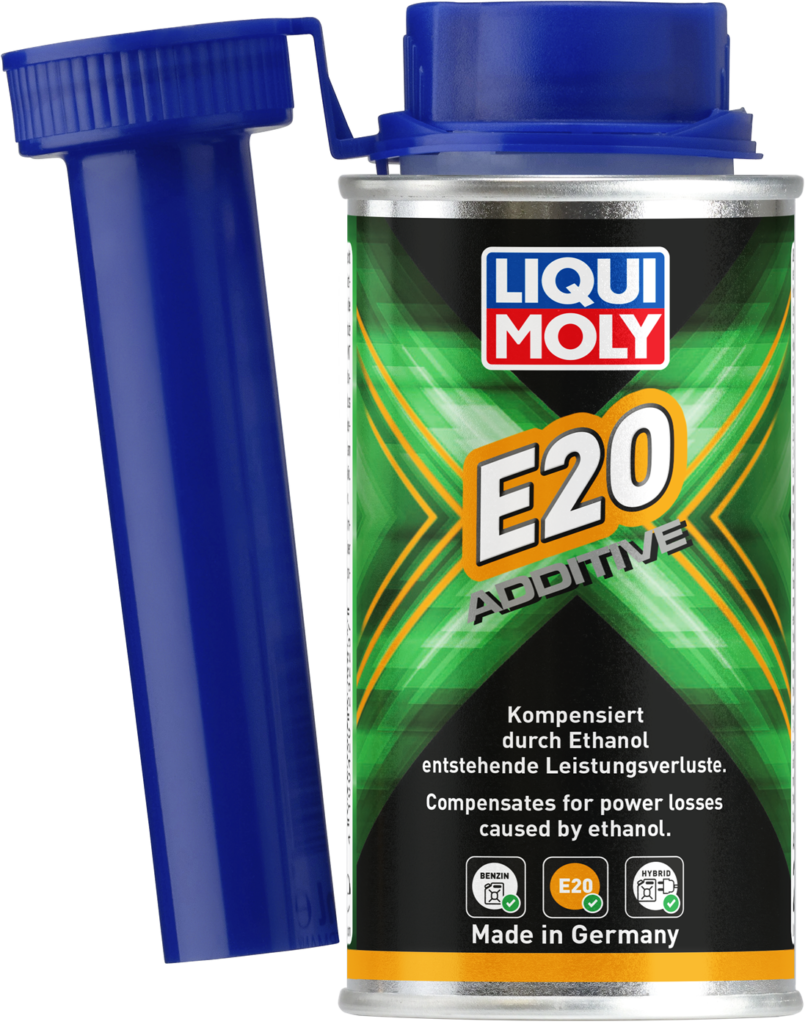
This guide covers everything you need to know including how to clean injectors, which additives work, and how to protect your specific car brand. For those looking for a proven, engineering-grade solution, we also examine the LIQUI MOLY E20 Additive, a product developed specifically to compensate for performance losses caused by high-ethanol fuels.
Why E20 Is the “Invisible Thief” of Your Car’s Mileage
The Energy Density Problem
The single biggest reason your fuel economy has dropped is physics. Ethanol contains roughly 33% less energy per litre than pure petrol. When your engine burns E20 fuel — a blend of 20% ethanol and 80% petrol — it effectively receives less energy per combustion cycle. The result is a 6-10% natural drop in real-world mileage that no amount of smooth acceleration or highway cruising can fully recover. If your Maruti Swift previously returned 18 km/l, you can now realistically expect 16-17 km/l under identical conditions. This is not a fault; it is the physics of ethanol blending.
The Moisture Problem: Phase Separation
Beyond energy density, ethanol has a hidden destructive quality — it is hygroscopic, meaning it actively absorbs water vapour from the surrounding air. Over time, especially during India’s monsoon season or in coastal cities with high humidity, this absorbed water accumulates inside your fuel tank. Once the water content crosses a critical threshold, a phenomenon called Phase Separation occurs: the water and ethanol separate from the petrol and sink to the bottom of the tank as a corrosive sludge.
This water-ethanol layer causes multiple problems simultaneously — it rusts the inside of your fuel tank, clogs fuel filters, stresses the fuel pump, and sends water-contaminated fuel directly to your injectors. The result is hard starts, rough idling, misfires, and, if left unchecked, a repair bill that can cross Rs. 20,000.
How LIQUI MOLY E20 Additive Directly Counters These Problems
The LIQUI MOLY E20 Additive is an engineering-grade fuel additive developed specifically to address the performance and protection gaps created by E20 fuel. Unlike generic additives, it is formulated as an advanced additive combination in a carrier liquid, rated for all 2-stroke and 4-stroke petrol engines — covering passenger cars, light commercial vehicles, and motorcycles. Here is how its verified properties map to the E20 problems your car faces:
| E20 Problem | LIQUI MOLY E20 Additive Action | Engine Benefit |
| Mileage loss from lower energy density | Optimizes the combustion process | Recovers combustion efficiency; reduces fuel consumed per km |
| Phase separation / water in fuel | Protects against fuel-water emulsions; antioxidant stabilization | Prevents corrosive sludge from reaching injectors and fuel pump |
| Injector deposits (port injection) | Cleans deposits on intake valves and manifold injectors | Restores spray pattern; improves idle quality and throttle response |
| GDi carbon buildup | Effectively removes deposits in GDi injectors | Critical for Hyundai GDi/Turbo engines prone to direct-injection fouling |
| Rubber lines and O-ring degradation | Fully compatible with engine and fuel system materials; corrosion inhibitor included | Extends life of ethanol-sensitive seals and fuel line components |
| Emissions and rough running | Reduces emissions; improves vehicle acceleration and smoothness | Supports BS6 Phase 2.0 compliance and smoother ECU fuelling maps |
Application: One Can Covers 40 Litres
One 150 ml can of LIQUI MOLY E20 Additive treats 40 litres of fuel. Add the entire contents of the can directly to the tank before filling with petrol — mixing takes place automatically. For most Indian passenger cars with a 35-45 liter tank, a single can treats one full fill-up. Use at every second or third fill-up for ongoing protection, or at every fill-up in high-humidity conditions (monsoon season, coastal cities).
How to Protect Your Non-E20 Car from Ethanol Damage: 4 Golden Rules
Rule #1: The “Half-Tank” Habit — Never Let Your Tank Run Low
The Tip: Never leave your car sitting with a near-empty tank for more than 48 hours.
The Logic: An empty tank is essentially a sealed container filled with humid air. The more air space above the fuel, the more moisture the ethanol has to absorb. By keeping your tank at least half full at all times, you dramatically reduce the air-to-fuel ratio inside the tank and slow down water absorption. This single habit costs nothing but saves thousands in potential repair costs.
Rule #2: Avoid Fuel Stagnation — Don’t Pre-Fill Before a Long Break
The Tip: If you are not planning to drive your car for more than 15 days, do not fill up the tank before parking it.
The Logic: Unlike pure petrol, E20 fuel begins to degrade chemically within 2-3 weeks. Stale E20 forms gum and varnish deposits inside the fuel system, which then coat the tiny spray nozzles of your fuel injectors. On popular cars like the Hyundai Grand i10 Nios or Honda Amaze, a single injector cleaning service can cost between Rs. 1,500 and Rs. 5,500. In severe cases involving GDi (Gasoline Direct Injection) engines, complete injector replacement can run up to Rs. 15,000 or more.
Rule #3: Use a 2026-Compliant Ethanol Stabilizer Additive
The Product: Look specifically for additives with an “E20 Compatible” label. Products such as E20 Additive, Proctane Evo, and Milex are formulated for 2026 Indian fuel standards.
The Benefit: These advanced additives work by chemically stabilizing fuel components through antioxidant action, preventing ethanol from bonding with atmospheric moisture. They also contain corrosion inhibitors that protect rubber fuel lines, aluminium fuel pump components, and injector O-rings — all of which are vulnerable to ethanol degradation. Importantly, do not use older or generic fuel additives on a BS6 Phase 2.0 car. The sensitive oxygen (O2) sensors in modern engines can be triggered by incompatible additives, illuminating the Check Engine light.
Rule #4: Shorten Your Service Interval
The Change: If your owner’s manual recommends servicing every 10,000 km, bring that forward to 7,500 km in the E20 era.
Why It Matters: Ethanol is a solvent. When it passes through worn or hot piston rings, it can blow into the crankcase and dilute your engine oil, reducing its viscosity and lubricating properties. Thin, contaminated oil accelerates wear on bearings, camshafts, and piston rings. Changing oil more frequently is the cheapest form of insurance — especially for older BS4 engines that were never designed with E20 in mind.
Brand-Specific Vulnerabilities to E20 Fuel (2026 Data)
| Car Brand | Key Vulnerability | Recommended Action |
| Maruti (Pre-2023 models) | Older rubber fuel hoses and carb-era seals may swell or crack with prolonged E20 exposure | Replace fuel lines with E20-rated hoses; use ethanol stabilizer every fill |
| Hyundai (GDi/Turbo engines) | Direct injection systems build up intake valve carbon deposits faster with ethanol blends | Walnut blasting or chemical decarbonization every 40,000 km; ultrasonic injector cleaning |
| Honda (i-VTEC engines) | VTEC solenoids are sensitive to oil dilution from ethanol blow-by; port injection nozzles prone to varnish | Shorten oil change intervals to 5,000-6,000 km; use E20 compatible injector cleaner |
Frequently Asked Questions
Is it still worth buying a Maruti in 2026 if Hyundai’s maintenance is getting cheaper?
Yes, absolutely. While Hyundai has made significant improvements in service transparency and spare part pricing, Maruti’s ecosystem still wins on Total Cost of Ownership (TCO) over a 7-year period. Maruti’s unmatched parts availability at local garages, superior resale value at the time of sale, and nationwide authorised service reach mean that the overall lifetime cost of owning a Maruti remains lower — even if individual service visits for some Hyundai models have become more competitively priced.
Can I use any fuel additive in my BS6 Phase 2.0 car?
No. In 2026, this is a critical distinction. You must look for additives with an “E20 Compatible” label on the packaging. The LIQUI MOLY E20 Additive is verified to be fully compatible with all engine and fuel system materials, making it suitable for modern BS6 Phase 2.0 vehicles. Modern BS6 Phase 2.0 vehicles are fitted with highly sensitive wideband O2 sensors and catalytic converters that react to chemical additives in the fuel. Using older or non-compliant additives can trigger false “Check Engine” warnings, disrupt closed-loop fuelling maps, and in rare cases, damage the catalytic converter. When in doubt, ask your authorised service centre for a recommended brand.
Why does my mileage drop specifically during winter or the monsoon with E20 fuel?
High ambient humidity is the key trigger. During India’s monsoon season (June-September) and in cold morning conditions, the relative humidity in the air inside your fuel tank rises sharply. This accelerates Phase Separation in E20 fuel — the ethanol-water sludge settles at the bottom of the tank, and the engine begins drawing a fuel mixture that is contaminated with water. A water-heavy fuel charge burns poorly, causing the ECU to inject more fuel to compensate, leading to a 10-15% temporary mileage drop during these seasons. Using a fuel stabilizer with anti-emulsion properties — such as the LIQUI MOLY E20 Additive — during these months is strongly recommended.
How much does professional injector cleaning cost in India in 2026?
The cost depends on the type of engine and the cleaning method used. A standard pressurized flush at an authorised service centre — suitable for most port-injection petrol engines — costs between Rs. 1,500 and Rs. 2,500. For GDi or Turbo engines (found in Hyundai Venue Turbo, Kia Sonet, etc.), ultrasonic injector cleaning, which requires removing and disassembling the injectors, costs between Rs. 3,500 and Rs. 5,500. If cleaning is delayed and injectors are damaged beyond recovery, replacement costs can reach Rs. 12,000-20,000 for a four-cylinder engine.
2026 Fuel Additive Quick Reference Table
| Product | E20 Compatible | Best For | Approx. Price | Key Benefit |
| LIQUI MOLY E20 Additive | Yes | All petrol engines (2-stroke, 4-stroke) | Check local retailer | GDi + port injector cleaning; fuel stabilization; corrosion protection; O2-sensor safe |
| Proctane Evo | Yes | All petrol engines | Rs. 350-450 / bottle | Prevents phase separation; cleans injectors |
| Milex E20 Shield | Yes | BS6 Phase 2.0 engines | Rs. 400-500 / bottle | O2 sensor safe; corrosion inhibitor for rubber lines |
| Wurth Injection Cleaner | Yes | GDi / Turbo engines | Rs. 600-750 / bottle | Deep injector cleaning; reduces carbon buildup |
| Generic / Older Additives | No | – | – | May trigger Check Engine light; avoid in 2026 |
Final Verdict:
The transition to E20 fuel is permanent. India’s ethanol blending targets are only set to increase beyond 2026, so adapting your ownership habits now is the smartest long-term decision. Start with the half-tank habit, switch to a 2026-certified ethanol stabilizer, and move your service interval to 7,500 km. If your car hasn’t had an injector service in the last 20,000 km, book a pressurized flush at your next service — it takes under an hour and costs less than a tank of fuel.
A well-maintained fuel system in the E20 era is the difference between a car that delivers 16 km/l and one that struggles to cross 13 km/l. The choice, and the savings, are entirely in your hands.

Mr. Ashish Kumar is the Founder of Carkayaar (Car Ka Yaar) and has more than 10 years of experience in the Indian automotive industry. He has spent years helping car owners, workshops, and businesses find genuine car spare parts, engine oils, filters, and other automotive products. Through his experience, he understands one of the biggest problems faced by car owners in India—finding genuine parts at the right price and getting honest advice. Many customers end up paying more because of duplicate products, multiple middlemen, or unnecessary repairs. At Carkayaar, Mr. Ashish Kumar has built a strong network of manufacturers and authorized brands. By buying directly from manufacturers, Carkayaar removes unnecessary middlemen, which helps reduce costs. These savings are passed on to customers, allowing them to buy genuine spare parts at better prices while avoiding duplicate or low-quality products. Mr. Ashish Kumar believes that buying the right part is only half the job. The other half is making sure the repair is done by a skilled and trusted mechanic. Through Carkayaar, he helps customers choose the right products and also guides them to reliable workshops whenever needed. Our goal is simple—to make car maintenance easy, honest, and affordable. Through every article on Carkayaar, he shares practical advice based on real experience, helping car owners understand their vehicles, avoid unnecessary expenses, and make better decisions with confident.